Initial AMRP Member

Eleni Mangou

Eleni Mangou is chemist and Head of the Chemical and Physical Research Department of the National Archaeological Museum in Athens since 1979.

She has a Bsc in Chemistry and a PhD from Patras University as well as an Msc in Archaeometallurgy and a Certificate in Archaeological Conservation from the Institute of Archaeology of London University.

Her PhD subject is on the Copper and its alloys in prehistoric Greece by examination of ancient copper artifacts from Aegean area, Crete and Mainland Greece dated to 4.000-1.000 B.C.

Her publications include 43 papers in refereed journals and conference proceedings as well as many contributions to archaeological monographs.

She has worked as a researcher in the Chemical Technology of the Chemistry Department of Patras University for six years (1973-1979).

She is member of the Greek Chemists’s Society, of the Greek Archaeometry Society and of the International Institute of Conservation of Works of Arts-Greek group.

Her research interestings are on the technology of ancient objects as metals, glass, faience, ceramic, organic materials and colours, on the research of conservation of ancient objects as well as on authentication problems. She has published a joint book with the conservator Th. Margiolopoulos on ‘Leather:Technology-Degratation-Conservation-Analysis’.

She has collaborated on the examination of the Antikythera Mechanism with radiographic X-rays techniques with Bromley and Wright in 1990 (Linear Tomography) and with the Group of the Antikythera Mechanism Research Project in 2005 (3D Microfocus X-Ray Tomography).
Mary Zafeiropoulou

Mary Zafeiropoulou († 2019) was a curator of antiquities in the Bronze Collection of the National Archaeological Museum, where she was dealing especially with the Antikythera Mechanism, discovering some new fragments. She studied history and archaeology at the National Kapodistrian University of Athens and also holded a degree in English Literature from the same university. She had a MA in Museum Studies from Leicester University and her dissertation was on “ The role and development of Archaeological Museums in Greece ”.

She has worked at the British, Birmingham and Leicestershire Museums and since 1973 in the Greek Archaeological Service conducting many excavations in Thasos, Seres, Athens and Eleusis. She has contributed to the writing of catalogues for exhibitions organized by the Greek Ministry of Culture, and to various publications.

Tony Freeth

Tony Freeth did a BA in pure mathematics and post-graduate degree (Part III of the Maths Tripos) at Cambridge University. Then at Bristol University he completed an MSc in Mathematical Logic (with commendation) and a PhD in Set Theory. He subsequently trained in film-making at the National Film & Television School in the UK and has spent 25 years as a freelance producer/director working in television and independent production. An award-winning film-maker, he also co-founded two independent production companies, Riverfront Pictures and Images First. He has worked for Thames Television, the BBC and Channel Four and his films have been shown internationally on channels such as Discovery. For international distribution he has also produced and directed a series on agricultural development in Sub-Saharan Africa, featuring the ideas of agricultural scientist, Dr Norman Borlaug, who won the Nobel Peace Prize in 1970. During 2000 he was inspired by Mike Edmunds to research and develop a film project about the Antikythera Mechanism. In doing this, he realized that much of the classic academic work on the Mechanism is wrong. This led to two research papers in Mediterranean Archaeology & Archaeometry. The first of these challenged the classic research on the Mechanism and proposed new investigations using the latest cutting-edge technologies of microfocus X-ray and digital imaging. Mike Edmunds initiative on the Antikythera Mechanism led to the formation of a new research team that became known as the Antikythera Mechanism Research Project (AMRP). After a four-year struggle, the AMRP got permission to carry out the investigations that Tony Freeth had proposed. In the autumn of 2005, Hewlett-Packard (USA) took a team led by Tom Malzbender to carry out digital surface investigations of the Mechanism using Polynomial Texture Mapping (PTM). Another team from X-Tek Systems (UK), led by Roger Hadland, carried out microfocus X-ray computed tomography (CT) on the fragments to get the crucial 3-D X-ray information. Together with his colleagues from the AMRP, Tony Freeth has been analyzing this rich data set ever since. The first results of this work were published in Nature in 2006 – Freeth et al. Decoding the ancient Greek astronomical calculator known as the Antikythera Mechanism. The AMRP organized a conference in Athens in 2006 to coincide with this publication. One aim of this conference was to extend the research team—particularly in the area of the history of ancient astronomy where our expertise was lacking. A collaboration with two distinguished historians of astronomy, Professor Alexander Jones and Dr John M. Steele, was one very positive result. A new paper in Nature was published on July 31st 2008 with co-authors, Tony Freeth, Alexander Jones, John M. Steele and Yanis Bitsakis. Tony Freeth now plans to return to the film project, through his film and TV production company, Images First Ltd. With superb documentary footage of the scientific investigations, beautiful images from the research data and an animated computer model of the Mechanism, the project still awaits commissioning. In the longer term, there are so many unresolved and fascinating questions about the Mechanism that still remain. Together with his colleagues, Tony Freeth aims to tackle these problems over the next few years.

Agamemnon Tselikas

Born in Patras, Greece, in 1949. In 1972 was graduated in Classical Philology from the School of Philosophy of the University of Athens. From 1973 to 1975 he hold a scholarship at the Greek Institute of Byzantine and Post-Byzantine Studies in Venice, where he specialized in Greek and Latin Palaeography, in particular in the Greek manuscripts of the 15th and 16th centuries under the supervision of the Prof. and academician M. Manoussakas. In 1976 he continued the palaeographical studies at the École Pratique in Paris. The years 1977-78 he spend as an associate at the Center for Byzantine Studies of the National Research Foundation in Athens. Since 1980 he has worked for the National Bank of Greece Cultural Foundation in the Center for History and Palaeography. In 1985 was appointed director of the Center. His chief work has been the creation and development of a microfilm-archive of Greek manuscripts from libraries in Greece, the Balkans and the Middle East. Up to the present he has completed 120 palaeographical missions during which 7.500 manuscripts have been microfilmed. In 1984 he organized a special seminar for the Palaeographical Center, which has become a fixture of the Cultural Foundation, in which he teaches Greek Palaeography at three levels. He has published catalogues of manuscripts of Greek Libraries (Patras, Chios, Cephalonia, Leros, Icaria, the Benaki Museum in Athens) and of the Libraries of the Greek Orthodox Patriarchates of Jerusalem and Alexandreia. Also, he teaches Greek Palaeography as invited professor in the Department of Literature of the University of Patras, the Department of Historical Studies of The Ionian University at Corfu and the Department of Cultural Sciences in the University of Bologna - Ravenna in Italy. Since 1999 he is the scientific consultant of the MILITOS editions. Over the last twenty-eight years he has published more than 150 articles on palaeographical studies, and continued the edition of the Archives of The Greek Revolution from the Parliament of Greece (5 volumes). He is member of the Society of The Greek Literature and Historical Archive (ELIA), the Institute of Research of Ancient and Medieval Alexandreia, and the “Arethas” Institute - Mediterranean Research Institute for Palaeography, Bibliology and History of Texts. He has participate in many international congresses and European networks, especially in the “Rinascimento Virtuale” European project, working for the analysis and recovery of palimpsests manuscripts.

For his work in the Patriarchate of Jerusalem was honored with the Cross of Holly Sepulchre.

John Hugh Seiradakis

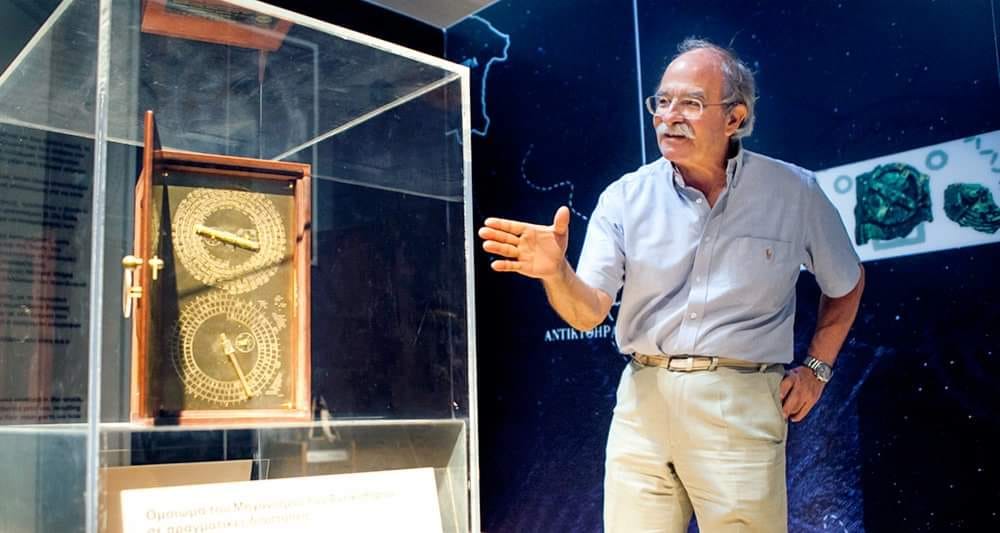
jhs mechanism.jpg

John Seiradakis was a radioastronomer and professor in the Department of Physics in the Aristotle University of Thessaloniki. After taking his first degree in Athens, he went to the Victoria University of Manchester in the UK where he completed his MSc and PhD. His main research interests are in Neutron Stars (Pulsar searches – Emission mechanisms – High frequency radio observations – High frequency polarization – Interstellar medium investigations), Flare Stars (UBV Optical Observations – Flare monitoring – Studies of the atmospheric activity of Flare Stars and RS CVn stars) and The Centre of our Galaxy (High frequency radio maps – Polarization – Modeling of radio observations).

With about 90 publications to his credit, he was very active both in research, teaching and the promotion of astronomy. His publications include 44 papers in refereed journal as well as educational books and conference proceedings. In addition to chairing many committees at his university and representing Greece on numerous European and international organizations, he has served as both Secretary and President of the Hellenic Astronomical Society.

Xenophon Moussas

Xenophon Moussas is a Professor of Space Physics at the National and Kapodistrian University of Athens.

He has a BSc in Physics (1971) and a Ph.D. (1977) from the from National and Kapodistrian University of Athens. He has 40 years of experience in Space Physics working at the University of Athens and at Imperial College of Science, Technology and Medicine (formerly Senior Visiting Research Fellow for many years).

He has written more than 110 articles in scientific journals, several in conference proceedings and several book reviews. He is co-author of a book on Space Physics (Greek Open University Publishing House, Patras, 2003), co-author of (a) Astrophysics, (b) Space Physics, (c) Astrophysics Laboratory Exercises, notes for the students.

He has supervised 25 PhDs (he presently supervises 4 PhD students), some 250 BSc theses and several MSc dissertations.

Research interests:

Space Physics: solar wind, STEREO mission (NASA, launched 2006), Ulysses mission, solar Alfven surface, the heliosphere in 2 D,

Cosmic rays,

Planetary environment Mars ionosphere and magnetosphere, Titan and Enceladus

Solar physics: ARTEMIS IV Digital Radio Spectrograph (7m diameter) at Thermopylae, Greece (French-Greek collaboration),

WIND/WAVES spacecraft experiment,

History of Astronomy: The Antikythera Mechanism, ancient celestial spheres.

More than 150 articles in encyclopedias.

Many popular science articles

Many Radio and TV programmes and interviews

Distinction: American Geophysical Union: editor’s citation for "excellence in refereeing" in Space Physics, Geophysical Research Letters, 2001.

NASA award, 2009,(Group achievement award to Ulysses team for outstanding multidisciplinary team effort which culminated in the highly successful operations and prolific scientific return of the Ulysses mission).

Hipparchus award of the Arcadia Cultural Organization.

Peer reviewer for European Science Foundation.

Exhibitions of the Antikythera Mechamism:

I had had several exhibitions or contributed to exhibitions: NASA, New York (Children Museum of Manhattan), UNESCO (Paris, inauguration of the International Year of Astronomy, Upsala Gustavianum Museum (the exhibition doubled the number of visitors in the year), The Library of Alexandria, Institute of Astronomy of the Slovac Academy, Crakow University, Olsztyn Planetarium (Copernicus observatory in Poland), Budapest, Cairo, Constantine (7eme salon' astronomie, Algeria), The Venetian Institute of Science, Letters and Arts, Cyprus, and many in Greece (Ionian Center, The University of Athens, University of Patras, many schools).

​http://scholar.google.gr/citations?user=b8aDvyIAAAAJ&hl=el

Yanis Bitsakis

Yanis Bitsakis got his BSc in Physics at the Faculty of Physics of Athens University, and a MSc in History of Science and Technology from the joint program at the University of Athens and the National Technical University of Athens. He is currently completing a PhD thesis on "The history of the Antikythera Mechanism and its educational implications".

From 2002, he worked at FORTH Photonics, a spin-off company of the Foundation for Research and Technology Hellas, as application specialist for the MuSIS systems (Multispectral Imaging System), in the field of analysis and conservation of objects of artistic and historical value; During this period, his major interest was the analysis and recovery of erased and overwritten texts on Byzantine parchments (palimpsests), in the scope of the "Rinascimento Virtuale" European program.

He joined the Antikythera Mechanism Research Project in 2005, as coordinator of the logistics of the data gathering phase and subsequently, as coordinator of the research on the inscriptions. He is now involved in educational and public understanding in relation to the Antikythera Mechanism, organizing conferences, lectures and exhibitions, developing and maintaining the website of the research project.

He is a member of the History, Philosophy and Didactics of Science and Technology Programme, a founding member of the Hellenic Society of History, Philosophy and Didactics of Science, member of the Association of Ancient Greek Technology Studies and of the International Council of Museums.

Mike Edmunds

Mike Edmunds is a Professor in the School of Physics and Astronomy at Cardiff University in Wales, and has just served as Head of School for 3 and 1/2 years. Both his first degree and PhD were from the University of Cambridge.

His main areas of research have been in the determination and interpretation of the chemical composition of galaxies and the Universe. He has also worked on the origin of interstellar dust. He has served on many committees and panels of the UK Research Councils, The Royal Astronomical Society and the Institute of Physics. He is currently a member of the Particle Physics and Astronomy Research Council.

He is lead academic on the Antikythera Mechanism Research Project, which is funded by the Leverhulme Trust.

He is author of more than a hundred academic papers. His 2004 invited George Darwin Lecture “The Elementary Universe” to the Royal Astronomical Society has been published in the August 2005 issue of Astronomy & Geophysics.

Subscribe to Initial AMRP Member